Case Study
How LENS Turned an Entire Community into a Classroom
Reimagining elementary education through nature, science, and authentic community partnerships.
The Challenge
Too often, students learn about the world without ever truly experiencing it.
Science is confined to textbooks.
History is reduced to facts and dates.
Communities become places students pass through rather than places where learning comes alive.
Rebecca Parks, principal of Southview Elementary in Kearney, Missouri, believed there was a better way.
She envisioned a school where curiosity replaced compliance, where learning extended beyond four classroom walls, and where every student could discover that the world around them was their greatest classroom.
That vision became LENS—Learning and Exploring Through Nature and Science.
The Vision
LENS was founded on one simple belief:
The most meaningful learning happens when students experience it firsthand.
Rather than asking students to memorize information, LENS invites them to investigate, explore, collaborate, and solve authentic problems.
The surrounding community becomes an extension of the classroom.
Nature becomes a teacher.
Local experts become mentors.
Students become active participants in their own learning.
As Rebecca describes it:
"It's taking your community and the expertise around you and using that to further education with kids and make it more meaningful… getting them to think, explore, soak in everything, and be excited."
Turning Community into Curriculum
One of the defining features of LENS is its deep partnership with internationally recognized paleoartist Gary Staub, a Kearney resident whose work appears in museums around the world, including the Smithsonian Institution.
Instead of inviting Gary to deliver a one-time presentation, LENS integrated his expertise directly into the curriculum.
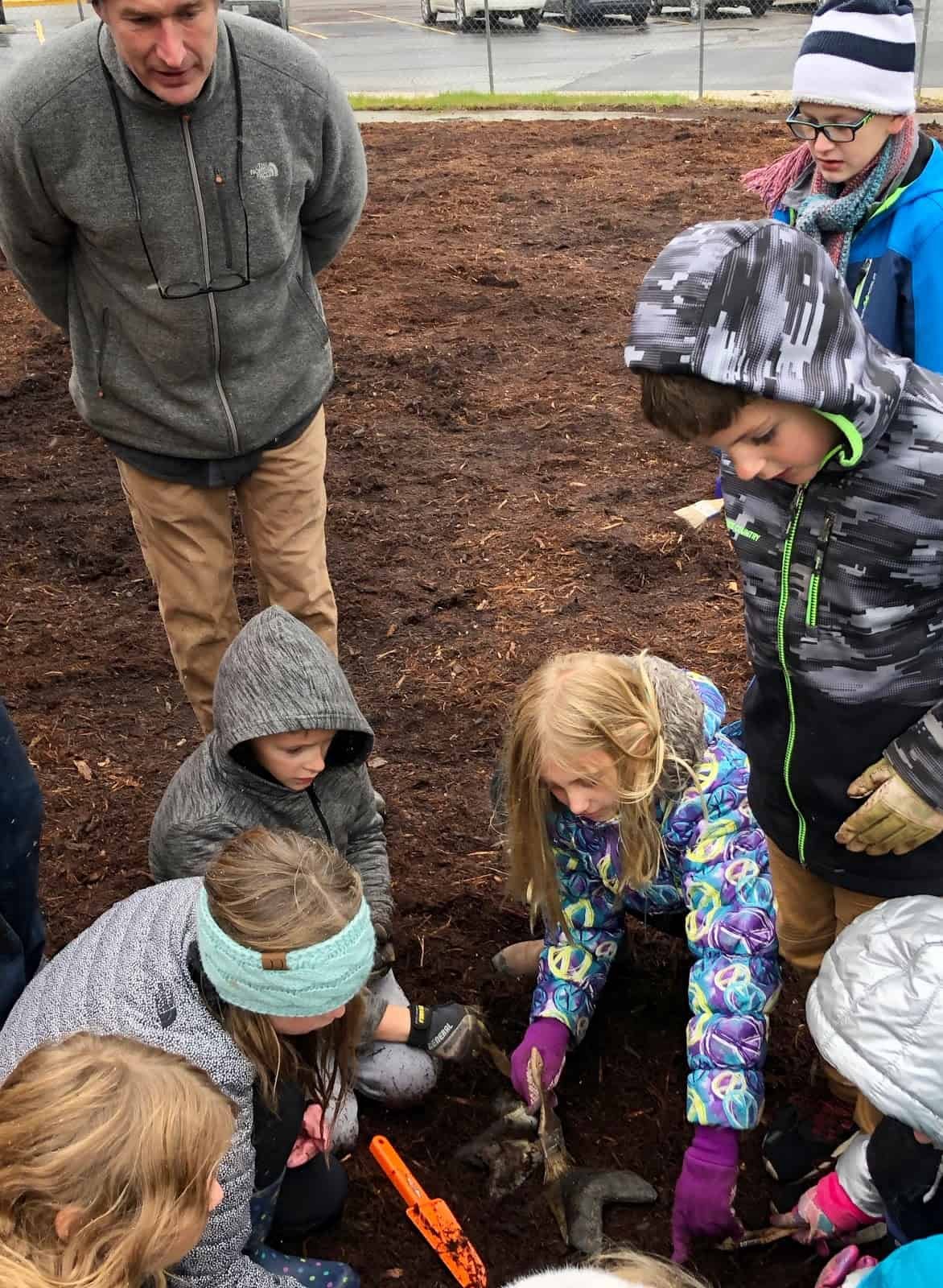
Students became paleontologists.
They participated in fossil digs.
They examined evidence.
They asked questions.
They developed theories.
They collaborated to solve problems.
Learning shifted from simply receiving information to discovering it.
As one visitor observed after watching students search for fossils on a cold winter afternoon:
"They don't look cold. They were so excited."
That excitement wasn't created by entertainment.
It was created by authentic learning.
Learning Beyond Four Walls
At LENS, the classroom doesn't end at the school doors.
Students regularly learn in:
Local parks and natural areas
Fossil excavation sites
Caves and wildlife habitats
Community organizations
Outdoor learning environments
These experiences aren't occasional field trips.
They're intentionally woven into daily instruction and aligned with academic standards.
Reading, writing, mathematics, science, communication, and collaboration all become part of authentic learning experiences connected to the real world.
More Than Nature and Science
Although LENS is built around nature and science, its true purpose reaches much further.
Rebecca's goal has never been simply to develop future scientists.
Her vision is to develop young people who are:
Curious learners
Critical thinkers
Collaborative teammates
Creative problem solvers
Confident leaders
As Rebecca explains:
"They're learning how to work collaboratively with one another and be problem solvers on their own… coming up with their own questions and thoughts."
Those are life skills that extend far beyond elementary school.
Why It Works
Children naturally learn through exploration.
When learning becomes personal and meaningful, engagement follows.
Students remember:
The fossil they discovered.
The cave they explored.
The questions they asked.
The problems they solved.
The community experts they met.
Those experiences create lasting memories because students are emotionally connected to their learning.
As Rebecca often says, students don't simply need more information—they need meaningful experiences that help them understand the world around them. That belief is reflected throughout her conversations about authentic, hands-on learning.
The Impact
LENS demonstrates that innovation doesn't require abandoning academic rigor.
Instead, it asks a different question:
What if we changed where—and how—students learn?
By connecting classroom learning to authentic experiences, LENS has created opportunities for students to develop:
Greater engagement
Stronger collaboration skills
Increased confidence
Critical thinking
Problem-solving abilities
Curiosity and wonder
Student agency
Real-world connections
Students don't simply complete assignments.
They become explorers.
Researchers.
Collaborators.
Contributors.
Lessons for School Leaders
One of the most powerful lessons from LENS is that every community already possesses extraordinary learning resources.
Every town has:
Local experts
Businesses
Nonprofit organizations
Parks and natural spaces
Historical landmarks
Civic leaders
Artists
Scientists
Stories waiting to be discovered
The opportunity isn't to replicate LENS exactly.
It's to uncover the unique assets that already exist in your own community and intentionally connect them to student learning.
The Beyond the Classroom Perspective
LENS demonstrates what becomes possible when schools move beyond traditional boundaries and embrace learning that is authentic, community-connected, and deeply meaningful.
At Beyond the Classroom, we believe every community has the potential to become a classroom.
Our work isn't about replacing great teaching.
It's about helping educators create learning experiences that spark curiosity, deepen engagement, and prepare students for a world that values creativity, collaboration, and problem solving.
Because when students experience learning—not just study it—they don't simply remember more.
They discover more.
Including what they're capable of becoming.
Ready to Reimagine Learning?
Beyond the Classroom partners with schools and districts to design community-connected learning experiences that increase student engagement, empower educators, and create lasting impact.
Let's explore what's possible—together.